Fraud Inquiries Focus on Public-Works Construction Hiring in New York
Public works projects in New York are among those under federal scrutiny, with contractors’ evasion of hiring requirements suspected.
Public works projects in New York are among those under federal scrutiny, with contractors’ evasion of hiring requirements suspected.

Hiroko Masuike for The New York Times
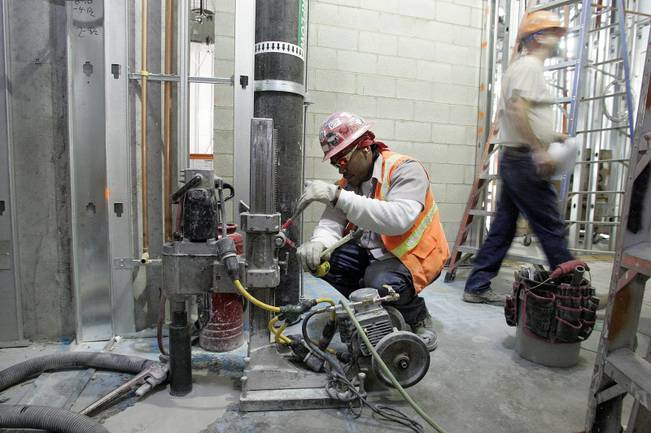
Workers from Skanska USA Civil Northeast at the Fulton Street Transit Center in Lower Manhattan. The company is the subject of an investigation by federal prosecutors in Manhattan.
By WILLIAM K. RASHBAUM
Published: November 23, 2010
Two of the nation’s major construction companies are under federal investigation, suspected of defrauding government programs on some of the biggest public-works projects in and around New York City, according to people briefed on the inquiries.
The projects under scrutiny include the city’s $2.8 billion Croton Water Treatment Plant and the Metropolitan Transportation Authority’s $1.4 billion Fulton Street Transit Center in Lower Manhattan, the people briefed on the investigations said.
The two inquiries focus on accusations that the contractors used what were essentially front companies to evade requirements that they hire a certain percentage of subcontractors owned by minorities or women, or businesses certified by government agencies as disadvantaged, the people said.
One of the investigations is expected to be resolved in the coming days with an agreement between one contractor under scrutiny, Schiavone Construction Company, and federal prosecutors in Brooklyn. The agreement will allow Schiavone, one of region’s biggest tunneling contractors, to avoid criminal charges but will require it to pay more than $20 million and maintain certain internal reforms it has put in place, the people said.
The second investigation focuses on Skanska USA Civil Northeast, a subsidiary of Skanska USA, which is ranked among the nation’s top 10 contractors in several categories, including transportation, general building revenue and new contracts, according to several of the people, who, like others interviewed for this article, spoke on the condition of anonymity because the cases had not yet been made public.
While that inquiry, which is being conducted by federal prosecutors in Manhattan, is not as far along, people briefed on that case said it could lead to a similar — perhaps even larger — payment.
Neither company has been charged with a crime.
A lawyer for Skanska, Martin Flumenbaum, said Tuesday: “We understand that there is a broad inquiry relating to the use of minority business enterprises in public-works construction projects in the New York area. Skanska is cooperating fully in connection with that inquiry and is committed fully to complying with laws and regulations governing the use of minority business enterprises.”
Austin V. Campriello, who represents Schiavone, declined to comment. The company was bought in 2007 by Dragados Inversiones USA, part of a Spanish construction conglomerate, after the conduct at the center of the investigation was said to have occurred.
Taken together, the two cases underscore what some law enforcement officials and analysts say is the systemic abuse of similar city, state and federal programs put in place in an effort to level the playing field for companies owned by minorities and women and those certified as disadvantaged.
In New York State, billions of dollars have flowed through this patchwork of programs in recent years, although precise figures are hard to compile.
The projects under scrutiny in the two investigations, which prosecutors are conducting with the transportation authority’s inspector general, are not the only major undertakings by Schiavone and Skanska in the city. In joint ventures with a third company, they are also involved in some of the authority’s most ambitious efforts. They have a $1.14 billion contract to build the tunnels and station structures for the No. 7 subway line extension and a $337 million contract to build some of the tunnels for the Second Avenue subway, though no accusations of wrongdoing have been raised in connection with those projects.
The schemes at the center of the two investigations are simple: Rather than hire a minority- or women-owned subcontractor or a company the federal government has certified as a struggling business, the contractors ran the payroll for their own workers — or paid another subcontractor — through a minority company that served as a “pass through.”
In the case of Schiavone, based in Secaucus, N.J., part of the scheme centered on a company hired to haul away dirt excavated from the water-treatment plant project and work at the $530 million South Ferry subway station renovation and at the Times Square station. The company did a tiny part of the work, while most of it was performed by another company, a mob-connected trucking firm, the people briefed on the case said.
Skanska, those with knowledge of that case said, paid workers for dewatering and demolition at the Fulton Street Transit Center site through a company called Environmental Energy Associates in Ridgefield, N.J. That company, a certified disadvantaged business enterprise, or D.B.E., collected a fee for the service it provided, handling just the payroll, the people said.
Representatives of the offices of the United States attorney in Brooklyn, Loretta E. Lynch, and the Manhattan United States attorney, Preet Bharara, declined to comment on Tuesday.
Several law enforcement officials who investigate construction corruption acknowledged that the goals for the participation of minority- and women-owned contractors and disadvantaged businesses often did not accurately reflect the universe of qualified companies.
A longtime construction industry official who has worked with community groups in an effort to increase the level of participation by female and minority contractors said the often-limited options had made a range of sometimes illegal — at times blatant — solutions commonplace.
The complex set of requirements for certification as a disadvantaged contractor includes being a member of what the federal government characterizes as a “socially or economically disadvantaged” group — women, blacks, Native Americans, Asians and others — as well as a $750,000 limit on personal net worth, a maximum average gross receipts for the business over three years of roughly $22 million and a certain measure of independence from non-D.B.E. firms.
Prosecutors, investigators and industry observers said it was hard to measure the scope of this type of fraud, but most agreed it was widespread. And while such crimes do not result in the theft of government funds — the money is paid and the work is done — they undermine the intent of the federal, state and local laws, which were written to create opportunities for struggling and minority- and women-owned companies. Also, in the view of some, they contribute to a culture of corruption in the industry.
Prosecutors in the United States attorney’s office in Brooklyn have long focused on such cases.
Its Federal Construction Fraud Task Force has made 61 arrests over the past decade for crimes related to this type of fraud. As a result, forfeiture orders have totaled more than $150 million, and 28 people and companies have been banned from seeking additional federal contracts, according to a recent court filing.
But while the United States attorney’s office in Manhattan has seldom made such cases, the investigation of Skanska signals an increased focus in this area for the prosecutors there, some officials have said.
The reasons seem clear. In the past year, New York City’s four-year-old program has resulted in $511 million in prime contracts and subcontracts for certified companies, according to the Mayor’s Office of Contract Services. Over the life of the city’s program — referred to as W/MBE, for women- and minority-owned business enterprise — more than $1 billion has gone to such contracts, according to the office.
At just one federal agency, the Transportation Department, a similar program resulted in $617 million worth of prime and subcontracts in 2009 in New York, New Jersey and Connecticut, officials said. That money was for highway and transportation projects, like the Metropolitan Transportation Authority ones under scrutiny in the two cases, the officials said. That federal program, which certifies and assists what it characterizes as disadvantaged business enterprises, was in some measure the model for the city’s effort.
The investigations developed in two ways. The Brooklyn inquiry grew out of a case focused on mob influence in the trucking industry and the work of an independent monitor who had been hired by the transportation authority to oversee the downtown projects after a scandal involving the construction of the agency’s headquarters, at 2 Broadway.
The trucking investigation uncovered the scheme at the water filtration plant, and the monitor, Toby Thacher, developed information indicating that the disadvantaged business enterprises working on the authority’s projects were fronts. The information was passed on to the office of the transportation authority’s inspector general, Barry Kluger. His office and the federal prosecutors, who in the Brooklyn case worked with the city’s Department of Investigation on the water-treatment plant inquiry, built the cases.
This article has been revised to reflect the following correction:
Correction: November 23, 2010
An earlier version of this article misstated the location of a water treatment facility for New York City.




 Posts
Posts


